The AI training day goes well. People enjoy the demos, someone asks a sharp question about client data, and the owner walks out thinking the team is ready. Three weeks later, two enthusiasts are using AI and everyone else has gone back to the old way.
Here is what works instead. AI training for a small business team sticks when it starts from jobs people already do, tells them plainly what they may use AI for, gets them practicing on their own work within a week, and brings them back to compare notes. A single session that teaches features, even a good one, rarely changes behavior on its own.
The evidence says the gap is not access. In a survey of 1,256 US small business owners in the Goldman Sachs 10,000 Small Businesses program, carried out from January 27 to February 4, 2026 and published on March 17, 2026, 76% said they currently use AI. Only 14% said AI is fully embedded in their core operations, and 73% said they would benefit from additional access to training and implementation resources. In the UK, the Department for Science, Innovation and Technology reported on January 28, 2026 research finding that only 21% of UK workers feel confident using AI at work.
That is where many small and medium-sized businesses (SMBs, or SMEs in the UK and Europe) sit today: using AI, but not yet using it well. Training closes the gap. Only one kind of training, though.
Why does most AI training fail to change how a team works?
Most AI training fails because it teaches the tool and then leaves people alone with it, while the research says their surroundings decide whether anything changes.
Microsoft's 2026 Work Trend Index, published on May 5, 2026 and based on a survey of 20,000 knowledge workers who use AI across 10 countries, found that "organizational factors like culture, manager support, and talent practices account for more than 2x the reported AI impact of individual factors like mindset and behavior (67% vs. 32%)." When managers actively modeled AI use, employees reported a 17-point lift in reported AI value.
Gallup's AI workplace indicator for US employees shows the same thing from the manager's chair. In its May 2026 figures, 36% of employees in AI-integrating organizations strongly agree that their manager supports their team's use of AI, and employees with that support are 1.7x as likely to use AI a few times a week or more.
Then there is the upskilling itself. BCG's AI at Work 2026 survey of close to 12,000 frontline employees, managers and leaders, published on June 2, 2026, found: "Close to three-quarters (72%) of all respondents say expectations for the skills they need have shifted; however, only 36% feel that they have received adequate upskilling."
Put those findings side by side and the lesson for an owner is uncomfortable. The session is the smallest part of training. What surrounds it (the permission, the manager, the week after) decides whether it works. It is one of the main reasons I see small businesses not getting value from AI yet.
The Four Rungs: what makes AI training stick
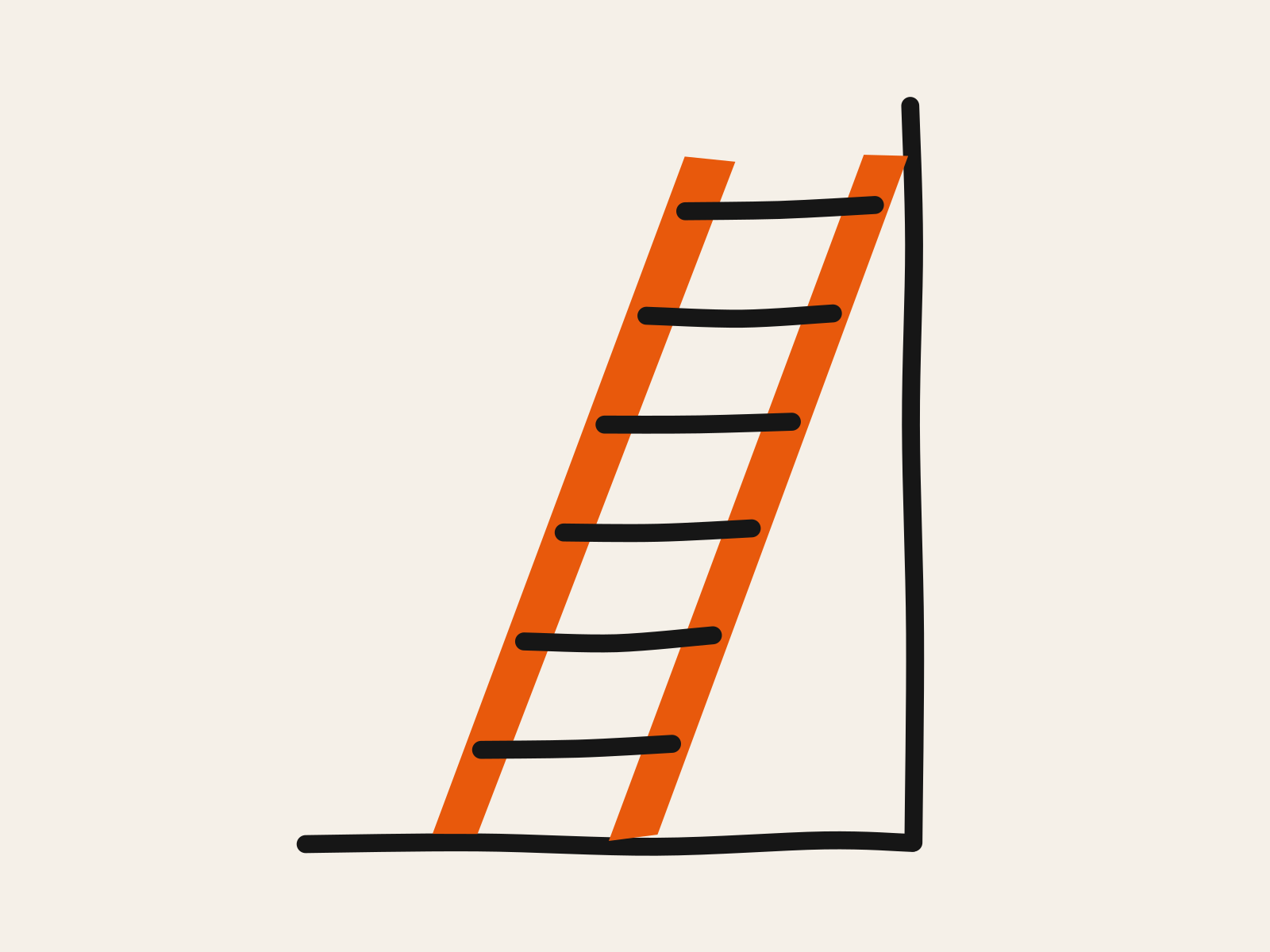
Training sticks when people have four things in place, in order, and it stalls at the first one missing. I call these the Four Rungs, and I offer them as a way of thinking about training rather than as established research:
The Four Rungs are what I suggest any workplace AI training must give people, in order, if it is to change what they do rather than what they know: a real job to use it on, clear permission, practice within the week, and a return. People climb only as far as the first missing rung, however good the session was.
Rung one: a real job
Train people on a task they do every week, not on what the tool can do. A generic session has a chatbot write a poem about the company. A useful one takes the follow-up email your office manager sent a client yesterday, rebuilds it with AI in front of the room, and then asks what would have been wrong to send. People remember the job long after the feature list has gone. Choose two or three jobs per team before anyone opens a laptop.
Rung two: clear permission
People need to leave knowing which tools they may use, what for, and what must never go in. Without that, the careful people quietly stop, and they are often your best people. A one-page note is enough to start: approved tools, the kinds of data that stay out (client personal details, anything under a confidentiality agreement), and who to ask when unsure. If you are deciding how formal that note needs to be, I have set out whether a small business needs an AI policy separately.
Rung three: practice within the week
In my experience, a skill tried once in a training room and not used again that week evaporates. Put one protected hour in each person's calendar in the week after the session. In that hour they use AI on one of their rung-one jobs and write down two things: what worked, and what went wrong.
Rung four: a return
Bring the group back two to four weeks later to show what they tried, failures included, and have the most senior person go first. The return session is where a manager models AI use in public, which is the behavior Microsoft's research links to higher reported value. It is also where a wrong answer from AI becomes something people mention rather than hide.
The order matters. A real job without permission produces nervous, secret experiments. Permission without practice produces a policy nobody has tested. Practice without a return leaves each person's lessons locked in their own head.
What Good Looks Like
Good AI training in a small business looks less like an event and more like a month of ordinary work done slightly differently.
| Training that fades | Training that sticks | |
|---|---|---|
| Starts from | What the tool can do | Jobs the team does every week |
| People leave with | A folder of prompts | One job to try and a note of what they may use |
| Managers | Book the session and skip it | Go first and show their own attempts |
| The week after | Nothing in the calendar | A protected hour for practice |
| Mistakes | Kept quiet | Shared at the return session |
| Success means | Good feedback on the day | People using it on real work a month later |
Across the business teams I train, the first question after a demonstration is rarely "how does it work?" It is some version of "am I allowed to?" That question tells you the room is ready to learn and is waiting on rung two. When the owner answers it clearly, on the spot, the questions that follow get sharper and more practical.
This is why I treat AI at work as a teaching problem more than a technology problem. As I put it on my business page: "The hard part of AI at work isn't the technology. It's helping people use it well, safely and every day. That's what an educator does." I have worked with organizations such as Welsh Water, Findel, Kahoot! and Grammarly, but my background is the classroom. I was a teacher, an assistant headteacher and a Director of Digital Strategy in further education: two decades of helping people learn new ways of working. Teachers learn early that a lesson is judged by what students can do next week, not by how the lesson felt. AI training deserves the same standard.
Who should you train first?
Train your managers first, then everyone, rather than relying on a handful of enthusiasts to carry it.
Enthusiasts find the good uses early and answer questions at the next desk. They cannot give permission, though, or make practice time appear in someone else's week. Managers can. In Microsoft's 2026 research, the most advanced AI users, whom it calls Frontier Professionals, were significantly more likely than other AI users to say their manager openly uses AI (85% vs. 64%). A manager who has tried AI on their own work and will show the result is the most direct way I know to move a team up the rungs.
A 30-day plan for a 20-person team
You can put all four rungs in place within a month, without a data team or a big project. Take a hypothetical 20-person property management firm.
Week 1: choose the jobs and write the permission. The owner and each manager list three jobs that eat time, such as replying to tenant emails, writing up inspections and drafting monthly landlord reports. The owner writes the one-page permission note. If you have not yet decided where AI fits in the business at all, start with how a small business should start using AI.
Week 2: train on the jobs. Managers go first, in a short session of their own. Then every person rebuilds one real piece of their own recent work. For UK staff who have never used AI, the government's AI Skills Hub courses, open to all UK adults online and taking "as little as under 20 minutes", can cover the basics beforehand. They cannot cover your jobs.
Week 3: practice. Everyone uses their protected hour and adds a line to a shared document: the job, what worked, what went wrong.
Week 4: return. A 45-minute session. The owner shows an attempt first, including one that went badly. The team keeps its two best examples as shared starting points and drops what failed.
What to do this week
- Write down three jobs in your business that people repeat every week and that involve drafting, summarizing or replying.
- Draft your one-page permission note: tools, data that stays out, who to ask.
- Book the return session before you book the training. In my experience it is the rung most often skipped, and a date in the calendar protects it.
How do you know the training worked?
Ask your staff, not your managers, three questions about a month after the training. I use what I call the Confidence Test:
"The Confidence Test is three questions I ask a member of staff, not their leader, to find out whether AI confidence exists in an organization: Do you know what you are allowed to use it for? Have you used it on your own work this week? If it got something wrong, would you tell someone? Confidence is when all three answers are yes from the people least likely to give them."
Each "no" points at a missing rung. A no to the first question means rung two never landed. A no to the second means the job was the wrong one or the practice never happened. A no to the third means nobody came back together to make mistakes normal. For a wider view than training alone, I have written about how ready your business is for AI across seven dimensions.
Where to go from here
If your team is using AI but nobody has shown them how to use it well on their own work, that is exactly what my AI training for teams is built for. If you would rather see where your business stands first, take the free Workplace AI Readiness Check; it takes about eight minutes.
Sources and further reading
- Survey: Small Businesses Embrace AI, But Need Training and Support to Fully Harness It, Goldman Sachs 10,000 Small Businesses, March 17, 2026.
- 2026 Work Trend Index report: Agents, human agency, and the opportunity for every organization, Microsoft WorkLab, May 5, 2026.
- AI at Work: Why Strategy Matters More Than Tools, Boston Consulting Group, June 2, 2026.
- Global Indicator: Artificial Intelligence, Gallup, figures as of May 2026.
- Free AI training for all, as government and industry programme expands to provide 10 million workers with key AI skills by 2030, Department for Science, Innovation and Technology (GOV.UK), January 28, 2026.
Dan Fitzpatrick is The AI Educator: a Forbes contributor, bestselling author and international keynote speaker who has trained more than 150,000 people across 30+ countries.