A small charity or social enterprise should start with AI on the work furthest from the people it serves: meeting notes, internal drafts and admin. Move closer, to funders and supporters and then to service materials, only as fast as your checking improves, and keep decisions about people human. I call this the Distance Rule, and the regulators' own guidance points the same way.
Sources checked November 20, 2026. I am not a lawyer, and this is not regulatory advice. The regulator material is for registered charities in England and Wales; social enterprises, and charities in Scotland and Northern Ireland, should check their own regulator. I have not read the guidance of the regulator for Community Interest Companies.
Why are small charities already ahead of their boards on AI?
Because the people doing the work have started, and the people responsible for it have not caught up. The Charity Digital Skills Report 2026, by Zoe Amar and Nissa Ramsay, drew 807 responses from charities, and Civil Society reported its release on July 9, 2026. It found that 79% of charities use AI tools in some way. It is an online survey that charities chose to answer, so I read the figures as a strong signal, not a census.
Look at what they use it for. Among the organization-wide uses the report lists, administration and project management comes first at 63% and grant fundraising follows at 45%. Service delivery sits at 9%. Nobody told the sector to work from the back office outward, and most of it has done so anyway. That is my reading; the report does not say it.
The gap is further up. The same report finds that 56% of charities name a lack of skills as their biggest barrier to AI, that 35% cite a lack of trust in AI tools (up from 15% in 2025), and that 33% say their board has poor AI skills. Enthusiasm falls as you climb the organization chart: 74% of CEOs and leaders say they are excited about AI's potential to increase efficiency and impact, against 60% of staff and managers and 47% of trustees. Only 27% of trustees say their culture encourages experimenting with AI, compared with 51% of CEOs.
So staff are using it, the chief executive is keen, the trustees are wary, and the rules are thin. That is a strategy problem, not a tools problem. A board that cannot see where AI is already in use cannot govern it, which is why shadow AI is the first thing to look for.
What does the regulator expect of trustees?
That trustees stay responsible, keep a human in charge and think about writing a policy. The Charity Commission for England and Wales has said so in two places, and the Fundraising Regulator has added a third.
In a blog post of April 2, 2024, the Commission wrote that it is "vital this process is not delegated to AI or based on AI generated content alone," and that it will "expect trustees and others in charities to ensure that human oversight is in place to prevent material errors." It suggested trustees consider whether an internal AI policy would help, and it flagged data security and extra care where the people a charity serves are children or share sensitive information. It also said: "We don’t currently anticipate producing specific new guidance on the use of AI." The existing duties are the guidance.
The Commission's Charity Sector Risk Assessment 2026, published August 18, 2026, repeats the point in a line under emerging technology risks: "trustees remain responsible for ensuring that appropriate safeguards, oversight and risk management are in place." It warns that misuse of AI "could contribute to increased risks to charity beneficiaries and employees." I found no separate AI statement from the Commission after the 2024 post, and the risk assessment has no AI section of its own.
For fundraising there is more detail. The Fundraising Regulator's guidance for using artificial intelligence in fundraising (the page shows "Last updated: 08/12/2025," which I read as December 8, 2025) begins with a sentence for every trustee: "You are responsible and accountable for your use of AI for fundraising purposes." It recommends that you "Develop and agree an AI policy before using any AI tools to support your fundraising," that you avoid using any AI tool "before conducting a risk assessment," that you test or pilot a tool and report to your board, that a person checks the accuracy, fairness and legality of what it produces, and that you tell donors about your use of AI in proportion to the risk of misleading them. It recommends against automated fundraising decisions without adequate human oversight.
What is the Distance Rule?
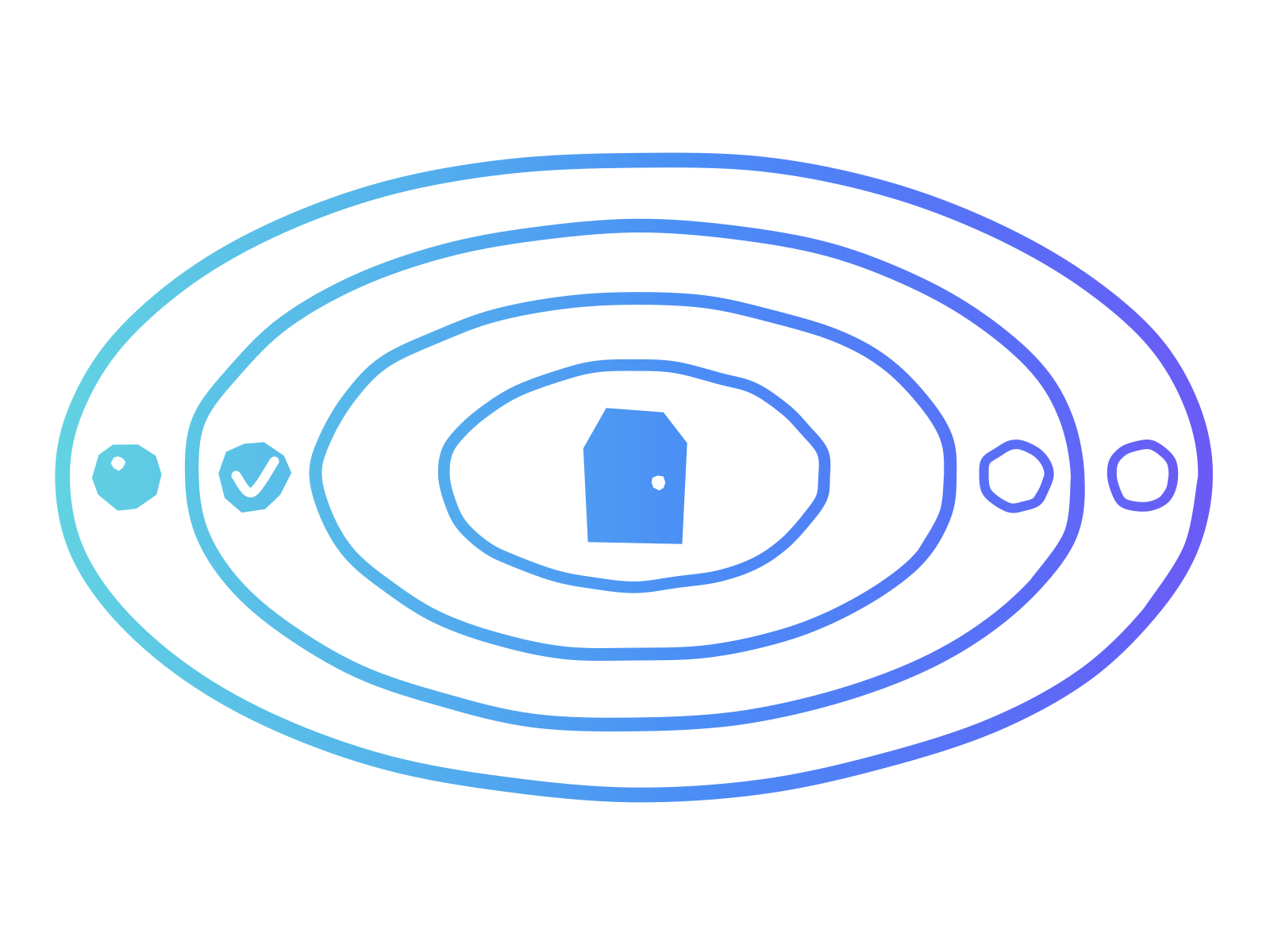
The Distance Rule is the way I suggest a small charity picks its first AI jobs, and it rests on one question about any task: if the output is wrong and nobody notices, who is hurt first?
The Distance Rule is how I suggest a small charity or social enterprise chooses its first AI jobs: start with the work furthest from the people you serve, and move closer only as fast as your checking improves.
If the answer is "us, a little," the job sits in the outer ring: a muddled set of minutes, an email that needed a second draft. If the answer is "a donor or a funder," it sits one ring in. If it is "someone we support," it sits closer still. If the output decides what happens to a person, it sits at the center, and I do not think AI belongs there at all.
It is my suggestion, not a regulation. What the regulators have said is the reason it is safe to propose: they put the weight on responsibility, oversight and care for beneficiaries, and distance from the beneficiary is the quickest way to see how much of each a job needs. It also gives a board something it can say yes to, which matters when 47% of trustees are excited and the rest are not.
Which jobs belong in which ring?
Most of a small charity's first jobs belong in the two outer rings, and the table shows what has to be true before a job moves in. It is my reading of the regulators' direction, set against the work a charity of ten or twenty people does every week. It is not the regulators' table.
| Ring | Kind of work | Examples | What must be true before you start |
|---|---|---|---|
| 1. Inside | Your own admin | Drafting trustee minutes, internal emails, rotas, tidying a spreadsheet with no personal data | An approved tool on an account the charity controls; one named person reads the output; nothing identifying anyone goes in |
| 2. Edge | What funders and supporters see | Bid drafts, newsletter copy, thank-you letters, social posts | A person checks every claim and figure; supporter data stays out of public tools; a policy exists; you can say, in proportion to the risk, how AI helped |
| 3. Service support | The materials and records around the people you serve | Session plans, easy-read leaflets, summaries of outcome reports, tidying case notes | A data protection check first; extra care where the people served are children or share sensitive information; a pilot reported to the board; a reviewer who passes the Loop Test |
| 4. Center | Decisions about people | Who gets support, safeguarding triage, eligibility, hiring and performance judgments | No AI decides. A person decides and can explain why |
Verdict: start in ring 1, open ring 2 once a month of ring 1 has gone cleanly, and treat ring 3 as a pilot with a report to the board. Ring 4 does not open. If you use AI to screen job applicants, that is ring 4 wearing an admin hat.
A word on the "reviewer who passes the Loop Test," because "a person checks it" is the easiest sentence in any policy and the hardest to mean.
The Loop Test is three questions I ask before accepting "a human checks it" as an answer: Would that person notice a wrong result without being told to look for it? Would they notice in time to stop it mattering? And if they missed it, could the work be put back? Oversight that survives all three is a safeguard. Oversight that fails any of them is a signature.
The closer a job sits to the people you serve, the harder the third question gets. A wrong date in the minutes can be put back. A wrong sentence in a letter to a family often cannot. If your people have never been shown how to check what comes back, start with how to train staff to check AI output.
What does a first month look like?
A month is enough to run one job in ring 1 properly and report on it. Take a hypothetical 12-person youth charity with a part-time chief executive, a board of seven and a handful of volunteers.
In the first week, the chief executive asks everyone, without blame, which AI tools they have already used for charity work, and writes the list down. She picks one ring 1 job: first drafts of the trustees' minutes. She chooses one tool the charity controls and tells people that names of young people never go into it.
In weeks two and three, the board secretary uses it for the next two meetings. She reads each draft against her own notes and keeps a tally of what she had to correct. In week four the board gets a one-page report: what was tried, what the tool got wrong, how long the drafts saved, and one question, "Do we open ring 2?" That report is what the Fundraising Regulator's advice to pilot and report back to the board looks like in a charity with no spare staff. Naming the person who owns the list and the tally is what I call an AI steward, and in a small charity it is a few hours a month, not a job.
I have one business story I can tell in public, and it is not a charity, so I am not claiming it proves a rule. In April 2023 I spoke about AI in marketing at a business event in Penrith. A year later the marketing team at theidol.com was using AI for content writing, and the managing director asked me back to show teams across the business what was possible. After the September 2024 session their IT Director wrote: "It was a great session and I've heard a lot of good feedback from the attendees." One team, one job, a year, and then the person at the top asking for more: that is the order I would copy.
What do funders and supporters need to be told?
At the moment, nobody has settled the etiquette, so the safe course is to be the charity that explains itself first. The Charity Digital Skills Report 2026 also surveyed 123 grantmakers: 38 grantmaking trusts and foundations and 85 other organizations that make grants. Among them, 13% ask applicants to declare their use of AI and 66% do not ask. A funder who does not ask today may well ask next year.
The Fundraising Regulator's wording is that you should "Be transparent with your donors about your use of AI," and that the greater the risk of misleading them, the more transparent you should be. A bid drafted with AI and checked line by line by the person who knows the project is low risk. A donor letter that invents a beneficiary story is not. One plain sentence in the cover note, saying what AI helped with and who checked it, costs nothing. My piece on when a business owes people a word about AI goes through the wording.
The Question to Ask Your Team
The question that tells you whether any of this is working is one you put to the people least likely to volunteer an answer. I use three, which I call the Confidence Test:
The Confidence Test is three questions I ask a member of staff, not their leader, to find out whether AI confidence exists in an organization: Do you know what you are allowed to use it for? Have you used it on your own work this week? If it got something wrong, would you tell someone? Confidence is when all three answers are yes from the people least likely to give them.
In a charity, "least likely" usually means a volunteer, a part-time support worker and a trustee who joined last year. Ask each one separately. The skills and trust gaps in the Charity Digital Skills Report suggest the third question is where the answers will break: 35% of charities cite a lack of trust in AI tools as a barrier, and a person who does not trust the tool and has not been told the rules will not tell you when it went wrong. How to tell your team about AI has a five-minute way to say what it is for.
What should a board do this week?
Put AI on the next agenda, and bring five things to the table. You can do all of them without a project or a consultant.
- Ask for the list. Which AI tools have staff and volunteers used for charity work in the last month? Expect it to be longer than the board thinks.
- Put every use in a ring. Anything in ring 4 stops. Anything in ring 3 pauses until it has a pilot and a data protection check.
- Name one person. One name against the list, the tally and the policy.
- Write one page. Start from my AI policy template for a UK small business and add a ring 4 line. If personal data has already gone into a public tool, my Paste Plan covers the first hour.
- Ask the Confidence Test of three people who are not on the board, and bring the answers to the meeting after.
Where to go from here
If your people are already using these tools and nobody has shown them how to check what comes back, that is what my AI training for business teams is built for. To see where your organization stands before you write anything, the free Business AI Readiness Scorecard takes about five minutes. If you organize a conference, a network or a members' event for charities and social enterprises and want this put to a room of leaders, it is one of the subjects I cover in keynotes for business audiences. For strategy and governance work with a board, start here or talk to me.
The people your charity serves will never see most of what AI does for you. Keep it that way until you are sure.
Sources and further reading
- The Charity Digital Skills Report 2026: artificial intelligence, Zoe Amar and Nissa Ramsay, 2026 (807 responses; released around July 9, 2026 according to Civil Society, July 9, 2026), with its grantmakers section.
- Charities and Artificial Intelligence, Paul Latham, Charity Commission for England and Wales, April 2, 2024.
- Charity Sector Risk Assessment 2026, Charity Commission, published August 18, 2026.
- Guidance for using artificial intelligence in fundraising, Fundraising Regulator, last updated December 8, 2025.
Dan Fitzpatrick is The AI Educator: a keynote speaker, Forbes contributor and five-times bestselling author who has trained more than 150,000 educators in more than 30 countries. More about Dan.